
Earth Reporters
.png)
Earth Reporters is a place-based citizen science program that engages youth in contributing environmental and climate related data. Participants gain new awareness and share their results as educators and changemakers in the community and beyond.
Earth Reporters investigate.
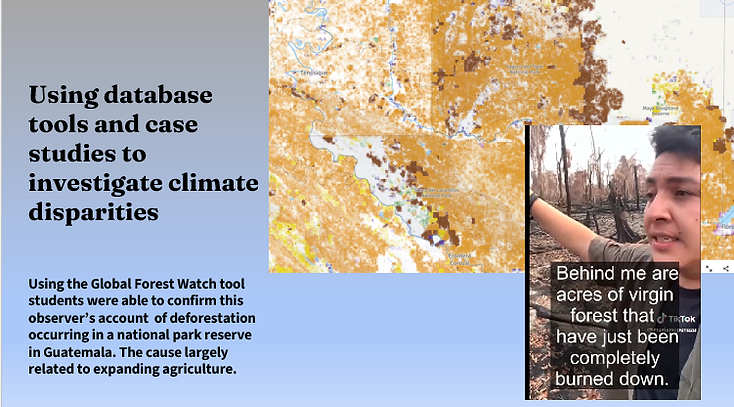
Earth Reporters contribute and share data and observations to a collaborative community-based portal along with other supporting tools and databases to better understand changes where they live. Data results can shine light on climate disparities and prompt measures such as environmental guardians, or changes in urban or rural development.
Community-based data collection empowers communities to contribute to the knowledge of our planet while promoting awareness of current threats at the local level.

Connect with community.
Be an investigative researcher.
What Is the Tree Equity Index?
TEI was developed by American Forests in partnership with Google and the University of Vermont. It is a tool that can show inequity as it relates to areas of low tree canopy urban neighborhoods in the U.S.
Data integration: The team created a methodology that combines multiple data sources:
-
Tree cover: Satellite imagery from sources like Google Tree Canopy.
-
Demographics: U.S. Census data, including information on income, race, and age.
-
Climate and health: Urban heat indexes and other climate and health factors.
The score is based on seven equally-weighted variables that help identify areas where residents are most vulnerable to heat, pollution, and other environmental hazards.
Areas with low tree cover or lower Tree Equity Index often face higher risks of urban heat islands often associated with climate and health disparities especially found in vulnerable populations.
https://www.treeequityscore.org/ is a database and tool that measures the TEI in neighborhoods based on tree cover, socioeconomics, ethnicity, age and population density.
https://insights.sustainability.google/ is Google's Canopy Tree Lab that is currently focused on Los Angeles.
.

Collect and Contribute data
Tell your story.


College student reflections
a. Student reflections after making observations in their two neighborhoods.
One student commented that housing appeared more crowded and close together in areas with low tree equity. Others noticed the air quality was different, or that the level and types of sounds were different. Others commented on the type of businesses and services provided were different between different neighborhoods. One made the connection between number of palm trees were higher in downtown urban areas versus shade trees. Many students were surprised by the fact that the distance between a neighborhood with low tree equity index between with a high TEI was only 10 minutes.
b. Comments also reveal knowledge as it relates to critical theory and new realizations related to systems of power. "When big organizations or governments make all the decisions and ignore local voices, the projects usually don’t last. Traditional knowledge gets pushed aside even though it’s super valuable and has kept ecosystems going for generations. If communities don’t have land rights or a real say, they have no reason to care about long-term restoration. But when power and knowledge are shared, everything becomes way more effective and sustainable."
c. "Power and knowledge matter because they decide who gets to make the rules about nature. If only governments or outside experts make decisions, local people may be ignored, and conservation may fail. Also, if only scientific
knowledge is used and local or Indigenous knowledge is not respected, important information can be lost."
d. "The lack of trees is not just an environmental problem; it is tied to housing segregation, disinvestment, and decades of urban planning that favor some neighborhoods over others. The data shows that tree equity is directly connected to racial equity, public health, and climate survival."